The debate between coworking spaces and working from home has moved beyond personal preference. For businesses in Egypt, whether you’re running a 5-person startup, managing a remote team, or operating as a solo consultant or Freelancers, the workspace you choose directly impacts how you grow, serve clients, and manage daily operations.
Both models promise flexibility, but they deliver fundamentally different experiences when it comes to scalability, professional credibility, and operational efficiency. This guide breaks down what actually matters for businesses and professionals navigating Egypt’s evolving work landscape.
Working from Home: When Flexibility Comes with Hidden Costs
Working from home became the default for many Egyptian businesses during the pandemic. For some, it stuck. For others, the limitations became clear once teams started growing or client expectations shifted.
Why Do Businesses Initially Choose WFH?
Immediate Cost Savings:
No rent, no commute expenses, no office setup costs. For early-stage startups and bootstrapped businesses, this model keeps overhead low while testing product-market fit.
Complete Schedule Control:
Teams set their own hours. Entrepreneurs can work late, take calls early, or handle personal responsibilities mid-day without rigid office constraints.
No Physical Infrastructure Needed:
You skip the hassle of furnishing an office, negotiating leases, or managing utilities. Everything runs from laptops and home internet connections.
Where does the Model Break Down?
Team Collaboration Suffers:
Video calls replace in-person brainstorming. Async communication slows decision-making. The spontaneous problem-solving that happens when teams work side-by-side disappears.
Client Credibility Takes a Hit:
Meeting a corporate client at a café doesn’t project the same professionalism as a proper Meeting room. Using your home address on business registration raises questions about stability and scale.
Operational Costs Are Hidden, Not Eliminated:
Home internet upgrades, ergonomic furniture, separate phone lines, productivity tools to replace office infrastructure, these add up. Many businesses underestimate the true cost of distributed WFH setups.
Work-Life Boundaries Collapse:
When your bedroom is your boardroom, burnout becomes inevitable. Entrepreneurs report working longer hours at home than they ever did in an office, with diminishing returns on productivity.
Scaling Becomes Complicated:
Hiring your third employee is easy. Hiring your tenth means coordinating across ten different home setups, with no central hub for collaboration, client meetings, or team culture.
Coworking Spaces: Infrastructure Built for How Businesses Operate
A coworking space isn’t a luxury, it’s operational infrastructure that businesses rent instead of own. It removes the burden of managing an office while providing the structure teams need to function efficiently.
What Coworking Actually Delivers?
Client-Ready Professional Environment:
Meeting rooms equipped for presentations. A business address that projects credibility. Reception services that handle clients professionally. These aren’t perks, they’re baseline requirements for businesses serving corporate clients or investors.
Separation Between Business and Personal Life:
Commuting to a workspace signals to your team that it’s work time. Leaving at the end of the day creates mental boundaries that reduce burnout and improve long-term performance.
Operational Infrastructure Included:
High-speed internet that doesn’t crash during client calls. Printing services. Conference equipment. IT support. Coffee and cleaning handled by someone else. You focus on running your business, not managing an office.
Networking That Happens Naturally:
You’re surrounded by other businesses, startups, consultants, SMEs, corporate teams. Collaboration opportunities, referrals, and partnerships develop organically when you work alongside people solving similar challenges.
Flexibility to Scale Without Long-Term Risk:
Start with a hot desk. Add a dedicated desk when you hire someone. Move to a private office when your team hits five people. Scale down during slow months. This adaptability eliminates the risk of traditional leases and upfront fit-out costs.
Multiple Locations for Distributed Operations:
If your business operates across Cairo, Giza, and Alexandria, coworking networks give you access to multiple branches under one membership. Meet clients closer to them. Let team members work from the nearest location.
The Tradeoffs
It Costs Money:
Memberships aren’t free. However, when you calculate the hidden costs of WFH, lost productivity, missed client opportunities, team coordination overhead, the ROI often justifies the investment.
Commuting Adds Time:
Getting to a workspace requires a commute. But for businesses that need team coordination and client meetings, centralizing operations in one professional space reduces total travel time compared to scattered home locations.
Shared Spaces Mean Less Privacy:
If you’re working from a hot desk, confidential calls require booking a private room. Private office options exist for businesses that need dedicated, enclosed space.
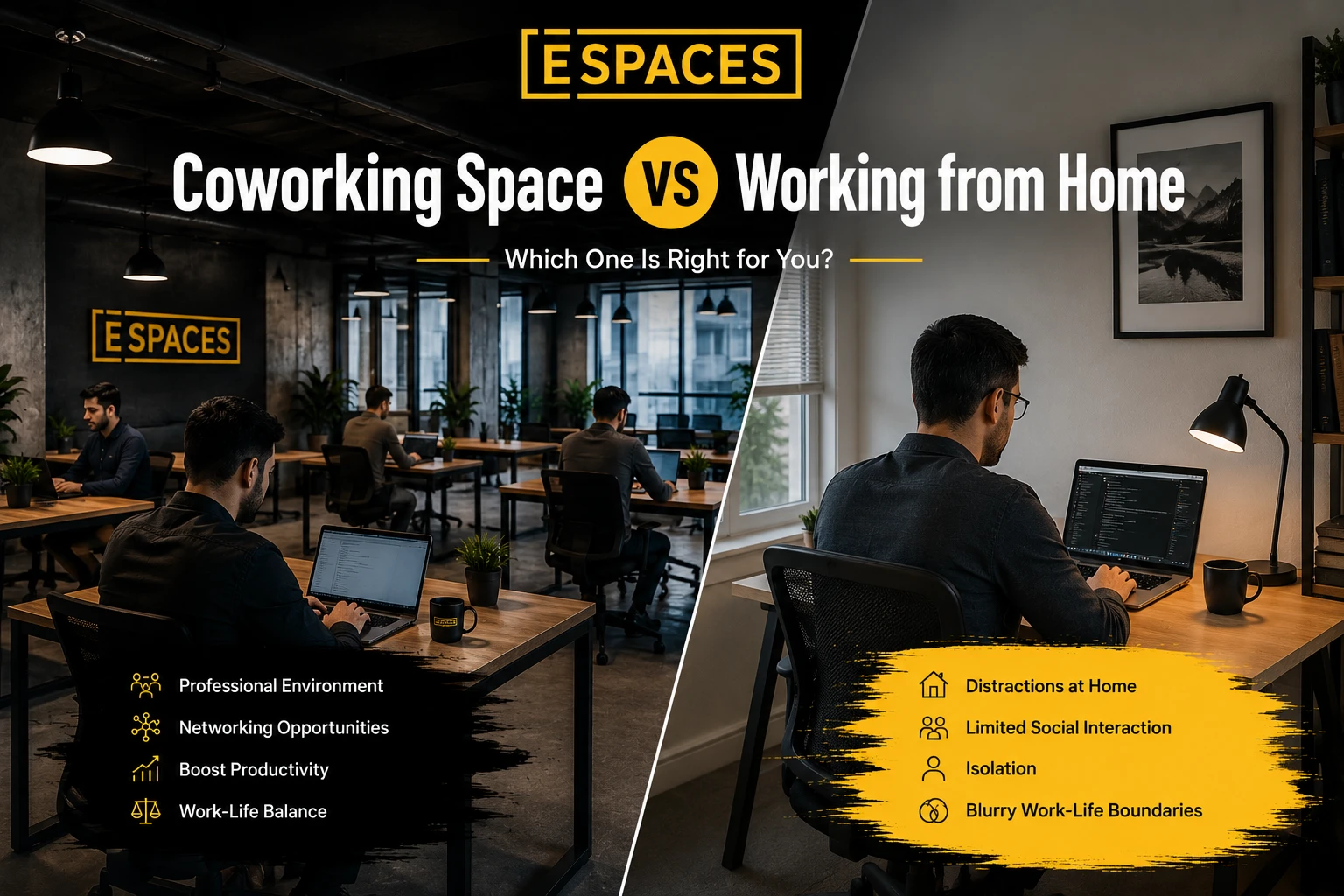
Direct Comparison: What Actually Matters for Business Operations
| Factor | Working from Home | Coworking Space |
| Team Collaboration | Async-only, video call fatigue | In-person brainstorming, real-time decisions |
| Client Credibility | Home address, café meetings | Professional address, equipped meeting rooms |
| Operational Costs | Hidden (furniture, internet, tools) | Transparent monthly fee, all-inclusive |
| Scalability | Complicated as team grows | Flexible plans that scale with headcount |
| Work-Life Balance | Boundaries blur easily | Clear mental separation |
| Infrastructure | DIY setup per person | Fully equipped, maintained by provider |
| Networking | Limited to virtual connections | In-person community, collaboration opportunities |
| Professional Development | Self-driven only | Events, workshops, peer learning |
Who Should Choose What? A Business-Stage Breakdown
Working from Home Makes Sense For:
Pre-Revenue Startups Testing Ideas:
If you’re in the earliest stage, validating product-market fit with no clients yet, WFH keeps costs low while you experiment.
Fully Digital Businesses with Zero Client Interaction:
E-commerce backend operations, content creators, or software developers working with overseas clients can operate remotely without sacrificing professionalism.
Solo Consultants in Hyper-Specialized Fields:
If your entire client base comes through referrals and you rarely meet anyone in person, WFH might suffice, though credibility still matters as you scale.
Coworking Spaces Work Best For:
Scalable Solutions for Teams of 2 to 100+ Employees:
Teams need space to collaborate, brainstorm, and coordinate. Coworking provides the infrastructure without the overhead of traditional leases.
Startups Serving Corporate or Institutional Clients:
If you’re pitching to banks, government entities, or large companies, a professional meeting space and business address are non-negotiable.
Freelancers and Consultants Building Client-Facing Businesses:
Designers, marketers, legal advisors, and consultants who meet clients regularly need spaces that project professionalism and credibility.
Remote Teams Requiring Occasional In-Person Collaboration:
Hybrid teams that work remotely most days but need periodic team meetings, workshops, or strategic planning sessions benefit from on-demand access to collaborative spaces.
Businesses Expanding Across Multiple Cities:
If your operations span Cairo, Alexandria, and Giza, coworking networks with multi-location access give your team flexibility to work closer to clients or home.
How Egypt’s Business Landscape Supports Flexible Workspaces?
Egypt’s entrepreneurial ecosystem has evolved significantly over the past decade. The rise of tech startups, consultancy firms, and SMEs has created demand for workspace solutions that prioritize flexibility over long-term commitments.
Industry data shows that coworking adoption in Egypt has grown steadily, driven by:
- The shift toward asset-light business models among startups and SMEs
- Corporate teams downsizing from expensive traditional offices to flexible spaces
- The need for professional infrastructure without the burden of leases, fit-outs, and facility management
- Access to business communities that support collaboration, networking, and growth
Why Are Espaces Built for How Egyptian Businesses Actually Operate?
e-spaces isn’t a trendy coworking brand, it’s a workspace partner designed for businesses that need reliable operations, professional environments, and the flexibility to scale without long-term risk.
What Makes e-spaces Different?
16+ Locations Across Egypt’s Business Districts:
With branches in New Cairo, Maadi, Nasr City, Dokki, Mohandeseen, Sheikh Zayed, 6th of October, and Alexandria, your business is never far from a workspace. Need to meet a client in Zamalek but your team works in New Cairo? Use any e-spaces location.
Operational Infrastructure from Day One:
High-speed internet, meeting rooms with presentation equipment, reception services, printing facilities, and coffee corners are all included. You walk in, start working, and focus on your actual business, not office logistics.
Flexible Plans That Scale with Your Business:
Start with a hot desk for a solo consultant. Add dedicated desks as you hire. Move to a private office when your team hits five people. Scale down during slow months. This adaptability removes the risk of traditional office leases.
A Community of Real Businesses, Not Just Freelancers:
e-spaces members include teams from Robusta, Jumia, El Araby Group, CIB Bank, Paymob, inDrive, and Breadfast. You’re working alongside businesses that are scaling, hiring, and solving real operational challenges, not just individuals passing through.
14 Years of Proven Track Record:
e-spaces has been operating since before “coworking” became mainstream in Egypt. That longevity means stability, proven operations, and a team that understands what businesses actually need to function smoothly.
360° Operations Handled In-House:
Maintenance, cleaning, reception, utilities, IT support, and facility management are handled by e-spaces. You don’t manage vendors, contracts, or operational headaches, you focus on growing your business.
Virtual Office Services for Multi-City Presence:
Need a legal address in Cairo and Alexandria without renting physical space in both? e-spaces’ virtual office service gives you professional addresses, mail handling, and call answering across locations.
Making the Transition: What Businesses Should Expect
If you’ve been operating from home and are considering a coworking space, here’s what the shift typically looks like:
Week 1-2: Operational Adjustment
Your team adapts to commuting and working in a structured environment. The separation between work and home becomes immediately noticeable.
Month 1: Routine Formation
Productivity stabilizes. Team collaboration improves. Client meetings become smoother because you have professional infrastructure backing you.
Month 2+: Long-Term Benefits
Networking starts happening naturally. You’ll connect with other businesses, exchange referrals, and potentially collaborate. The structure becomes a growth advantage rather than a constraint.
FAQs
How much does coworking cost for a small team in Cairo?
Pricing varies by location, team size, and membership type. Most coworking spaces offer daily, weekly, and monthly plans. Shared desks are the most cost-effective, while private offices provide dedicated space for teams. Contact providers for custom quotes based on your specific needs.
Can I use e-spaces for just one day or one week?
Yes. e-spaces offers daily and weekly passes, making it easy to test the space before committing to a longer-term plan.
Do coworking spaces have meeting rooms for client presentations?
Absolutely. Meeting rooms and conference facilities are standard at coworking spaces like e-spaces. They’re bookable by the hour and come fully equipped with presentation tools, whiteboards, and video conferencing setups.
Is coworking membership tax-deductible as a business expense?
In most cases, yes. Coworking memberships are typically classified as operational business expenses. Consult with your accountant to confirm how this applies to your specific tax situation.
What if I need a business address but don’t need physical space daily?
That’s where virtual office services come in. You get a professional address for business registration, mail handling, and call answering without needing to rent a desk or office full-time.
Can my team access multiple e-spaces locations?
Yes. With 16+ branches across Egypt, e-spaces members can work from multiple locations depending on their plan. This is especially useful for client meetings, working closer to home, or supporting distributed teams.
What amenities are included in a typical coworking membership?
Most memberships include high-speed WiFi, printing services, coffee and refreshments, reception support, and access to communal areas. Private office members also get dedicated desks, storage, and meeting room credits.
How does coworking compare to renting a traditional office?
Traditional offices require long-term leases, upfront fit-out costs, furniture, utilities, cleaning contracts, and facility management. Coworking spaces bundle all of this into one monthly fee with flexible terms, making it easier to scale up or down without financial risk.
The Bottom Line: Choose the Model That Supports How You Operate
The decision between coworking and working from home isn’t ideological, it’s operational. The right choice depends on your business stage, client expectations, team structure, and growth plans.
If you’re a solo consultant in the earliest stages with no client meetings and extreme budget constraints, WFH might work temporarily. But if you’re building a business that serves clients, scales a team, or needs professional credibility, coworking spaces eliminate the infrastructure barriers that slow growth.
For businesses in Egypt looking for flexibility without long-term risk, operational support without overhead, and a professional environment that scales with growth, coworking spaces offer a practical solution.
Ready to See How e-spaces Supports Your Business?
If you’re ready to move beyond the limitations of working from home and need a workspace that actually supports your operations, explore e-spaces’ flexible options.
With 16+ locations across Egypt, daily to monthly plans, and a community of real businesses, e-spaces is built for how teams work today, not how offices worked 20 years ago.
Book a Venue at any e-spaces branch. Walk through the space, meet the team, and see if it’s the right operational fit for your business.